
Saint Mary's Newsroom / Campus Notes
Winona Campus Newsletter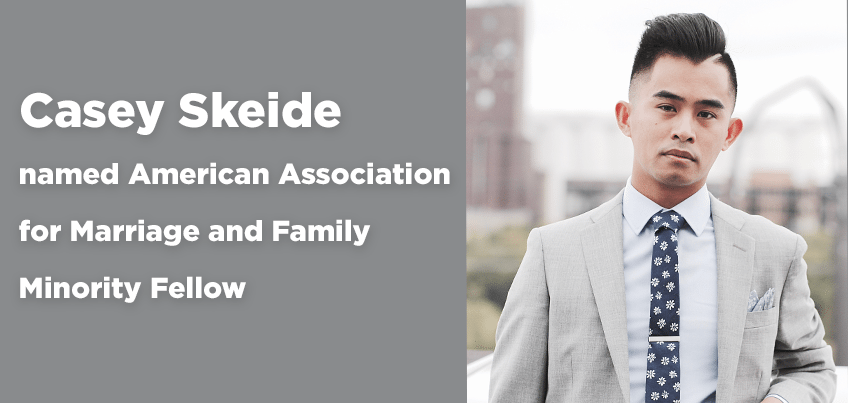
National fellowship awarded to graduate student in MFT program
By Stacia Vogel
Graduate student Casey Skeide has been named a 2017-2018 American Association for Marriage and Family Therapy (AAMFT) Minority Fellow. This national award is highly competitive and from the AAMFT Research and Education Foundation with grant support from the Substance Abuse and Mental Health Services Administration (SAMHSA).
Skeide is among a select group of individuals chosen for the Now Is The Time: Minority Fellowship Program for Youth (NITT-MFP-Y). Aimed at helping strengthen our nation’s youth and communities, this fellowship program provides significant financial and professional development support to students who are interested in providing access to and improving the behavioral health care services for racially and ethnically diverse children, adolescents, youth, and individuals in transition to adulthood.
“Without a doubt, this is a privilege to nurture my skills as a therapist and it’s a major milestone in my career and life,” said Skeide, who is a student in the Saint Mary’s Master of Arts in Marriage and Family Therapy program.
“As a marriage and family therapy student, one of the very first lessons that one learns is of the interconnectedness and systemic nature of all human interaction. In communities that I am from and work together with, it is not the individual that makes the community, but the community that makes the individual.” Skeide said. “With this notion, I have always sought institutions and experiences that exemplify this, and Saint Mary’s University of Minnesota is no exception. Saint Mary’s MFT program is dedicated to the nurturing and empowering of learners to live lives of service and leadership and I believe are able to do so because of the emphasis on community.”
With this fellowship, Skeide will have the opportunity for national trainings in MFT leadership, attendance and recognition at the 2017 annual AAMFT conference in Atlanta, as well as mentorship.
“The Saint Mary’s graduate school community could not be more proud of Casey Skeide for being selected as an AAMFT Minority Fellowship recipient. The goals of the fellowship program are in complete alignment with our Lasallian values of access, social justice, and culturally responsive service. This fellowship aims to expand the delivery of culturally competent mental health services to underserved people as well as to increase the number of culturally competent therapists. Skeide embodies these values with all of their passion, energy, and creativity in academia, research, and in direct client service. Our community is better for having Skeide in it,” said Samantha Zaid, Ph.D., Rev., L.M.F.T., who is Director of the Marriage and Family Therapy Graduate Program at Saint Mary’s University of Minnesota.
A little more about the fellowship: In 2014, the Now Is The Time: Minority Fellowship Program-Youth was established. This Fellowship was part of President Obama’s Plan, Now Is the Time, to increase access to mental health services for youth in America. The objectives of the NITT: MFP-Y are to reduce health disparities and improve behavioral health care outcomes for racially and ethnically diverse populations by increasing the number of culturally competent master’s-level behavioral health professionals serving children, adolescents, and populations in transition to adulthood (ages 16 to 25) in an effort to increase access to, and quality of, behavioral health care for this age group. The MFP is Substance Abuse and Mental Health Services Administration’s (SAMHSA) premier mental health workforce development training program focused on mental health disparities faced by underserved and minority communities. For more about AAMFT, visit their website.
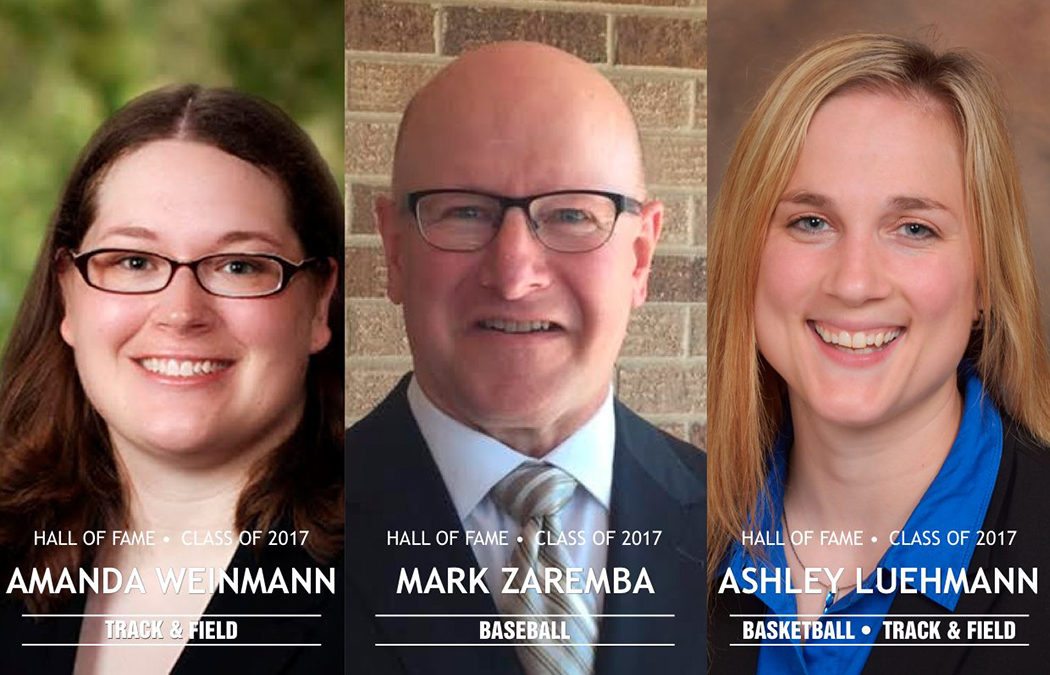
Three to be inducted into Saint Mary’s Sports Hall of Fame
The Saint Mary’s Cardinal ‘M’ Club, in association with the Alumni Association, will induct three members into the Saint Mary’s Sports Hall of Fame during Cardinal ‘M’ Club Weekend Friday-Sunday, Sept. 8-10.
The 2017 Saint Mary’s University Sports Hall of Fame induction ceremony will honor former student-athletes Mark Zaremba ’78, Amanda Weinmann ’07, and Ashley Luehmann ’07
The trio will be honored during an awards ceremony on Friday, Sept. 8. Along with the induction of this year’s Hall of Fame class, Friday’s ceremony will also honor Saint Mary’s 2016-17 postseason award-winners, as well as unveiling the 2016-17 Outstanding Male and Female Athletes, and Outstanding Male and Female Scholar Athletes.
Here’s a look at this year’s Hall of Fame inductees:
MARK ZAREMBA ’78
Zaremba played in 118 games during his four seasons with the Saint Mary’s baseball team, compiling a .289 batting average—going 86-for-296 with 14 doubles, three triples and five home runs. He drove in 51 career runs and was walked 40 times. Zaremba enjoyed his best statistical season in 1978, when he hit .427 (41-for-96), with seven doubles, five triples, and three home runs. He scored 22 runs that junior season. His five triples during his junior season rank No. 2 all-time and his 25 walks as a senior in 1978 rank third, while his eight career triples leave him sitting sixth all-time.
AMANDA WEINMANN ’07
Weinmann had a storied career as a member of the Saint Mary’s track and field team, claiming two Minnesota Intercollegiate Athletic Conference titles, three First-Team All-MIAC honors, not to mention earning NCAA Division III All-American honors three times in the shot put. Weinmann saved her best year for last, being crowned conference champion in both the weight throw (indoors) and shot put (outdoors), while also earning All-American honors in each of those events at the NCAA Division III National Championships. A double-major in bio-physics and engineering with a 3.99 GPA, Weinmann was selected Saint Mary’s 2007 Outstanding Female Athlete and Outstanding Scholar Athlete. She was also named 2007 MIAC Woman of the Year, was selected as one of the 10 NCAA Division III finalists for the NCAA Woman of the Year—not to mention earning ESPN The Magazine Academic All-America honors, and was one of 10 NCAA Division III female spring sport student-athletes awarded post-graduate scholarships by the NCAA. A three-time MIAC All-Academic Team selection and twice named to the USTFCCCA All-Academic Team, Weinmann still holds the school record in the indoor shot put (13.46m), indoor weight throw (16.71m), and the outdoor shot put (13.72m).
ASHLEY LUEHMANN ’07
Luehmann was a standout in two sports during her time at Saint Mary’s, spending her winter months leading the Cardinal women’s basketball team, before trading in her sneakers for track cleats in the spring. Luehmann was a three-time All-MIAC First-Team selection in basketball, and still holds the single-season and career records in 3-pointers made and 3-pointers attempted. She closed out her career scoring 1,438 points, and also ranks among the program’s top 10 all-time in blocked shots, free throws made, field goals made, field goals attempted, free throws attempted, steals, and games played. As a field event specialist for the track and field team, Luehmann was the MIAC champion in the indoor shot put in 2007, was a six-time All-MIAC First-Teamer, made three NCAA Division III national championship appearances, and earned All-American honors with a sixth-place showing in the javelin in 2007. She was a two-time USTFCCCA All-Academic Team selection and still holds the school’s outdoor records in the discus and javelin.
Student-athlete scores with NFL team internship

Saint Mary’s golf athlete Brett Jackson ’18 recently traded in his Cardinal red for brown and orange, as the senior marketing and sports management double major had a unique opportunity to intern with the Cleveland Browns.
As a summer intern in the Browns’ Fan Experience and Special Events Department, Jackson focused on project management and event planning, helping to run important summer visibility and development events, like a golf tournament and barbecues.
“I did all of the event planning for two of our big barbecues, one for the coaches and the other for our corporate partnerships and suite holders,” he said. “The highlight of my summer was the barbecue at the head coach’s house that was for all of the coaching staff, executive team, football operations, and ownership. There were over 100 people there. It was extremely detailed and had to run smoothly. I worked on that event for close to a month, everything from the catering aspect to a big gift giveaway.”
Jackson spent the end of his internship focusing on training camp activities; he helped implement and execute activities for fans who were able to attend 17 open practices. “We had to create an environment for the fans to enjoy,” Jackson said. “It’s gritty manual work, from helping out with the 40-yard dash to the inflatables.”
Jackson is grateful for this inside look at the business side of the sports industry. “I wanted to see how a professional sports organization is run on different levels,” he said.
He also knows that an internship is a great way to start building a network of connections. “The connections you make are vital,” he said. “Getting the internship is the first step; then it’s about how you maximize the opportunity and create your own identity within your time at the internship. It is extremely difficult to get a position with any big sports team without a prior internship or experience.”
Jackson believes this experience will help to set himself apart from the competition after he graduates.
Corey Kinder, Jackson’s internship supervisor and the manager of Fan Experience and Special Events, said that he looks for students who show initiative, are willing to put in long hours, and handle stress well.
“Brett fit the role perfectly,” Kinder said. “He came off very polished and professional. His experience as a student-athlete certainly helped as well because we know student-athletes handle multiple tasks at once. Brett dove right in and was quick to adapt to changes.”
Kinder praised Jackson’s ability to immerse himself in the community and culture of a team and city he was unfamiliar with. “What’s interesting about Brett is that he brings a fresh perspective to the project,” Kinder said. “Someone not from Ohio might not necessarily understand Cleveland Browns fans, the passion from the fans, or the city’s undying support, but Brett took the initiative to truly experience Cleveland.”
![Ground broken on Rochester expansion [video]](https://newsroom.smumn.edu/wp-content/uploads/2018/03/CascadeGroundBreaking01.jpg)
Ground broken on Rochester expansion [video]
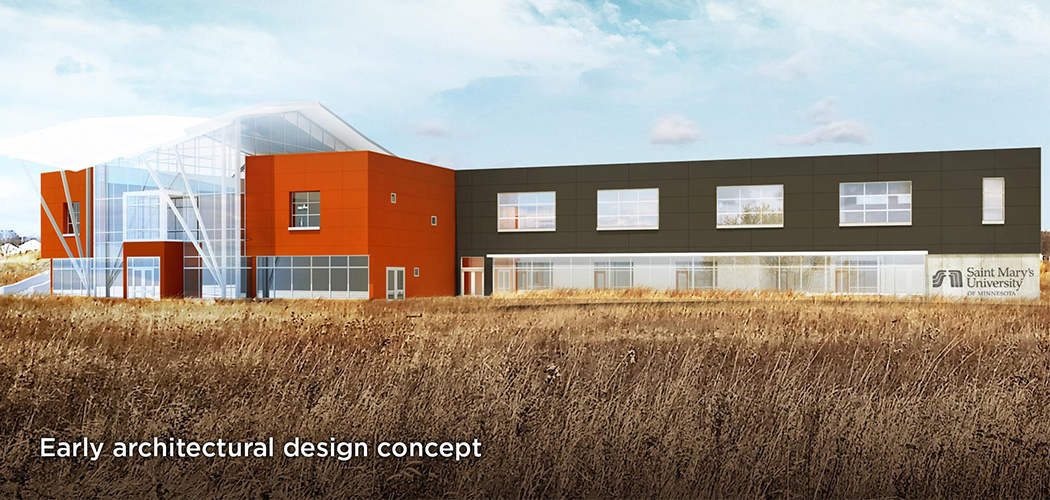
Nearly 100 guests joined Saint Mary’s University of Minnesota as it broke ground for a new 10,000-square-foot addition to Cascade Meadow Wetlands and Environmental Learning Center in Rochester on Aug. 15.
Although the event celebrated a physical expansion, the excitement multiplied as university officials discussed the programming that will take place inside.
Once approved by state and regional accrediting bodies, this expanded Saint Mary’s facility will house the graduate portion of a proposed 3+2 Physician Assistant program, a collaborative effort with the Mayo Clinic School of Health Sciences.
Participants chosen for the program could potentially become a physician assistant in as little as five years—spending three years studying at Saint Mary’s Winona Campus, followed by two years of graduate study at Cascade Meadow.
Students successfully completing the program will earn a bachelor’s degree from Saint Mary’s University of Minnesota and a Master of Health Sciences in Physician Assistant Studies from Mayo Clinic School of Health Sciences.
This new addition will also house programming within the university’s Schools of Graduate and Professional Programs. Saint Mary’s has had an educational presence in Rochester since 1985.
A generous $5 million gift from Jack and Mary Ann (Wera) CST’64 Remick of Rochester will support the building expansion and programming.
Scott Walker, associate vice president, partnerships-Rochester, and executive director of Cascade Meadow, said that “when longtime Saint Mary’s University supporters Jack and Mary Ann Remick gifted this beautiful facility to Saint Mary’s in 2015, we began envisioning the ways we could best utilize this natural environment and expand upon the important work Jack Remick had started.
 “Cascade Meadow continues to be a regional resource for environmental education,” Walker said. “Our students—as well as students throughout the region—are finding that the hands-on learning opportunities here in this diverse ecological system are invaluable.
“It’s because of the Remicks’ continued generous support and leadership, that we will expand and growour Rochester presence and usher in a new educational opportunity to help Rochester continue to thrive.”
Luis Escobar ’12 provided a unique perspective as a Saint Mary’s alumnus who is working as a certified physician assistant at the Mayo Clinic Health System in St. James, Minn.
“I’m a proud Saint Mary’s University alum, and I am honored to work for the Mayo Clinic Health System. I can also attest that a career as a physician assistant is a very rewarding one,” he said. “I was excited to hear about the proposed collaboration between the Mayo Clinic School of Health Sciences and Saint Mary’s University for a physician assistant program. Physician assistants play a very direct role in being of service to others.
“Working for the Mayo Health System, we are part of an unbelievable support system,” he added. “Every medical provider working within Mayo Clinic Health System is equipped to give our patients the best care. This proposed Physician Assistant program would be a tremendous asset to students. Being able to learn from the best in the nation would be a dream come true for many Saint Mary’s students.”
Audrey Kintzi, vice president for Development and Alumni Relations added, “Saint Mary’s students deserve an education that prepares them to address the needs of tomorrow, and they deserve an environment that meets their expectations as well as their drive and determination. It makes me incredibly happy that we are now able to house such very important study and work in a wonderful new facility.”
Brother William Mann, Saint Mary’s president, told attendees that the ground breaking was just part of the growth occurring at Saint Mary’s. “We are proud to be in Rochester. We’re proud to be collaborating with the Mayo Clinic,” he said. “Today is only the beginning. That was our promise in (our 2012) centennial. It’s not just that we got to 100 (years), but we got to 100 strong and determined. Because of our friends, we continue to do great things.”
DLR Group is serving as the architect of the project, and McGough Construction will serve as general contractor. Construction will begin Sept. 1.
View KIMT’s news coverage of the event.
Groundbreaking participants included (from left): Amado Guevara, project manager, DLR Group; Abigail Propsom ’19, Cascade Meadow intern; Dr. Michael Silber, dean, Mayo Clinic School of Health Sciences; Brother William, Saint Mary’s president; Mary Ann (Wera) Remick CST’64, chair, Saint Mary’s Board of Trustees; Jack Remick, founder, Cascade Meadow; Luis Escobar ’12, physician assistant, Mayo Clinic Health System; and Dan Melbostad, general manager, McGough Construction.
Saint Mary’s University to break ground on Cascade Meadow expansion
ROCHESTER, Minn. — Saint Mary’s University of Minnesota invites the public to a groundbreaking for the expansion of its Cascade Meadow Wetlands and Environmental Science Center in Rochester.
The event, planned for 11 a.m. Tuesday, Aug. 15, will be held at Cascade Meadow, located at 2900 19th St. NW, Rochester.
Saint Mary’s University strives to meet the evolving needs of its students, as well as the community. Once approved by state and regional accrediting bodies, this expansion will house the graduate portion of a new 3+2 Physician Assistant Program, a collaboration between Saint Mary’s University of Minnesota and Mayo Clinic’s School of Health Sciences. This program is being developed to meet future patient needs in the area.
The expansion will also house the university’s growing Schools of Graduate and Professional Programs. Saint Mary’s has had an educational presence in Rochester since 1985 and currently offers bachelor’s, master’s, and doctoral degrees from its Rochester location.
DLR Group is serving as the architect of the project, and McGough Construction will serve as general contractor. Construction on the nearly 10,000-square-foot addition will begin immediately after the groundbreaking, and is estimated to be completed by summer 2018. This expansion is made possible through generous benefactors Jack and Mary Ann Remick of Rochester.
R.S.V.P.s are requested by Aug. 7 to smumn.edu/cmgroundbreaking or 507-457-6647.

Cascade Meadow hosts fine furniture exhibit
ROCHESTER, Minn. — “The Art of Fine Furniture”—an exhibit featuring the creations of professional and hobbyist studio furniture makers from Minnesota and Wisconsin—will be on display at Cascade Meadow Wetlands and Environmental Science Center from Aug. 19 through Sept. 30.
The show—free and open to the public—will relocate from its current location at the Winona County History Center, which has hosted the exhibit annually since 2013.
Furniture by definition is “the movable objects in a room that make it fit for living.” The show’s participants believe furniture is more than that and that the aesthetics, quality, and feeling one receives from an exceptional piece of furniture are as important as its traditional functional use.
The show is made up of pieces of studio furniture that invite and excite a curiosity to explore the inner mysteries and workings of the pieces in the exhibit. The pieces are meant to inspire viewers to build their own furniture and/or to own one of the pieces in the exhibit. Most of the pieces are for sale and can be purchased from artists directly. Artist contact information is available at the exhibit.
Artists featured include: Dale Johnson, Mark Laub, Jamie Schell, Tim Gorman, Jason Holtz, Linda Sue Eastman, Craig Jentz, Peter Wright, Richard Helgeson, Ed Neu, Roger Knudson, Joel Nichols, Steve Robb, Jeff Hand, and Richard Tendick.
An artist reception will be held from 1 to 3 p.m. Saturday, Aug. 19, at Cascade Meadow, 2900 19th St. NW, Rochester.
For more information, go to www.theartoffinefurniture.com.
Caption: A piece by furniture artist Mark Laub.
The sky’s the limit on psychology careers
When psychology Ph.D. students are applying for internship experiences, they may shoot for the moon—but they don’t often think of turning to NASA.
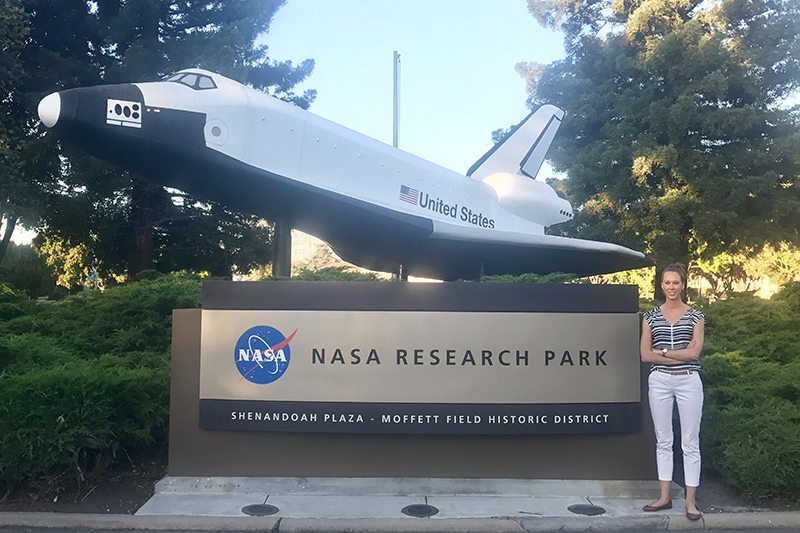
As a summer intern with the Office of Naval Research at NASA Ames in Moffett Field, Calif., 2014 Saint Mary’s undergraduate psychology major Ellie Niedbala has been involved with helping astronauts and military personnel learn to deter motion sickness and stress. And, she’s working to both recruit and retain more women to NASA Ames.
Looking back at her career path, Niedbala knew by sophomore year that she had a love of psychology but she wasn’t sure exactly what area she wanted to pursue.
Undergraduate experience
As an undergrad, she shadowed a school psychologist in the Winona Area Public Schools system. “I was counseling students, learning about different therapies, and evaluating their cognitive abilities,” she said. “I loved the internship, but that experience showed me that I didn’t want to go into therapy or clinical psychology. I wanted to go into research.”
By senior year, she joined Dr. Elizabeth Seebach’s Body Image Lab where she and a group of students designed a survey, administered it, analyzed the data, and presented the findings at a conference in Washington, D.C.
“That gave me a taste of the research process from beginning to end—which is exactly what I do now—so it was really beneficial,” she said.
Niedbala credits her professors with supporting her and helping her determine the right career path. After graduating from Saint Mary’s, she was accepted into a Ph.D. program in experimental social psychology at Texas Tech University.
Graduate study
At Texas Tech, she is specializing in group processes or behavior, specifically group conflict, inter-group violence, and stereotyping.
It’s a subject particularly interesting in today’s society. Eventually Niedbala would love to work in government or in a military research lab. “I am interested in doing big data analysis of terrorist activity, or working in a research lab with military personnel—training them or studying group processes and how that relates to their initiatives,” she said.
Interning at NASA
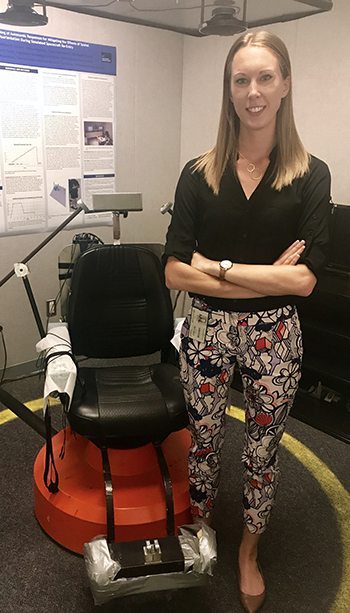 Part of the time, she is working in a psychophysiological lab in the human systems integration division with Dr. Patricia Cowings, who trains astronauts and military personnel to inhibit motion sickness and stress, which can be disruptive during military or space missions.
“She teaches them to control their physiological processes using autogenic feedback therapy that she designed,” Niedbala said. “Over several training sessions, her participants learn how to voluntarily control 24 physiological responses including heartrate, body temperature, blood pressure … so that while they are in flight or on a mission, they are able to reduce the symptoms of malaise. Or in an emergency situation, they have better control over their stress response and are better able to respond in crisis.”
Niedbala said she hooks participants up to physiological sensors and takes their vitals before and after they sit in a special rotating chair, which can spin at 30 rpm.
“With more training, participants are able to tolerate longer rotation sessions with less severe symptoms,” she said.
She then compiles the data, analyzes it, and displays it visually in graphs to track improvement.
Outside of that lab, she is also working on initiatives to increase female representation in STEM positions at NASA Ames. “STEM fields have historically had extremely low proportions of females, so we’re designing an action plan to increase the number of women applicants, and using a couple of specific strategies,” she said. The first is to identify universities with above-average representation of women in STEM. The second is to evaluate specific language usage in web content and job descriptions.
“The language used in job postings has an effect on whether a woman will want to apply,” she said. “Often there is a lot of masculine wording—like ‘dominant’ and ‘competitive,’ ” which may cause women to be less attracted to those positions. We’re looking deeper into the language and making recommendations to the recruitment teams.”
On a related project, she is serving on a task force working to install more nursing rooms at NASA Ames. “NASA values diversity and inclusion by providing more facilities for new mothers,” she said. “We’re surveying buildings, talking to mothers, and finding out where there is available space to install more nursing rooms in the future. Hopefully we’re helping with recruitment but also the retention of females here at NASA.”
Niedbala said she is loving her summer experience. “I still can’t believe I’m here,” she said. “It’s a great experience and very motivating to be in this environment, where everyone loves what they’re doing.”

Serving the medically underserved
Peter Carlson ’13 is in the business of preventing emergencies.
At North Memorial Medical Center, a team of community paramedics makes scheduled house calls to elderly patients to conduct basic tests, explain medication restrictions and schedules, and check for safety hazards in the home. A part of the Population Management division at NMMC, the North Memorial Community Paramedic department aims to prevent emergencies and reduce emergency care costs.
Carlson supervises the community paramedics team and works with people from multiple departments, including finance, contract teams, and primary care, to ensure the program runs smoothly for both patients and paramedics.
Carlson’s courses in the B.S. in Healthcare and Human Services Management program at Saint Mary’s, now available in St. Cloud and Rochester, discussed ethics and current events, such as the Affordable Care Act, which helped him gain a solid understanding of healthcare reform.
“My coursework was timely,” Carlson said. “I was able to witness what I was learning and make more sense of what was going on around me.”
Carlson travels around the country speaking to a wide variety of audiences about the community paramedics program at North Memorial. The crowd can vary from a rural health clinic to a major healthcare conference, such as EMS World. He presents analytics showing the program’s impact on community health and reduction in total cost of care.
“Saint Mary’s made me more comfortable with oral presentations and boosted my confidence,” Carlson said.
One of the first community paramedics to be certified in the nation, Carlson has been interviewed about the program by the Star Tribune and the Wall Street Journal.
Inspired by his parents who were active in the community, Carlson started his career in healthcare as a rural volunteer Emergency Medical Technician (EMT) 12 years ago. He put his college education on hold in order to become a paramedic.
“When I applied to Saint Mary’s, I was happy with my place in my career,” Carlson said. “However, completing my bachelor’s degree has really benefited me by improving my salary and advancing my position at NMMC. It’s the end result that motivated me to go back to school.”
Learn more about Saint Mary’s Health and Human Services programs for bachelor’s completion and advanced degrees.

Exploring the possibilities of regenerative medicine
Two weeks ago Bailey O’Hare ’19 didn’t know that much about amyotrophic lateral sclerosis (ALS), and she knew even less about regenerative medicine.
As part of a new summer workshop at Saint Mary’s University, O’Hare is getting an in-depth look at how the emerging field of regenerative medicine could one day help patients suffering from ALS—as well as a multitude of other diseases and ailments.
O’Hare and 18 other select undergraduate sophomore and junior science majors from seven colleges are participating in Saint Mary’s first Advancing Regenerative Medicine (ARM) grant-funded workshop May 29-June 9 on the Winona Campus.
O’Hare, a junior Biology major at Saint Mary’s, said that she hopes to pursue a career in medicine, and she knew that learning more about the fast-growing field would be beneficial. “In many cases traditional medicine is limited to treating the symptoms of a disease and unfortunately not solving the root cause of the problem,” she said.
The groundbreaking and evolving discipline of regenerative medicine has tremendous potential to impact the treatment of diseases affecting various organ systems—from tissue growth for burn victims to growing new vital organs, such as hearts and kidneys.
“The potential for self-repair can lead to an improvement in the quality of life—and even sustain life—for many patients,” O’Hare said. “Major breakthroughs are just around the corner. In many cases researchers are working to be able to take cells from a patient suffering from a disease or condition, treat them to become an induced pluripotent stem cell, and inject them back into the same patient. This is very important because it alleviates the risk of rejection due to the need to suppress the immune system when cells from another individual are used.”
As part of the hands-on workshop, students have been broken into teams for theoretical and practical learning experiences. O’Hare’s team is researching, writing, and presenting about ALS. Students are also working on two lab projects in the cell culture labs of Saint Mary’s new Science and Learning Center.
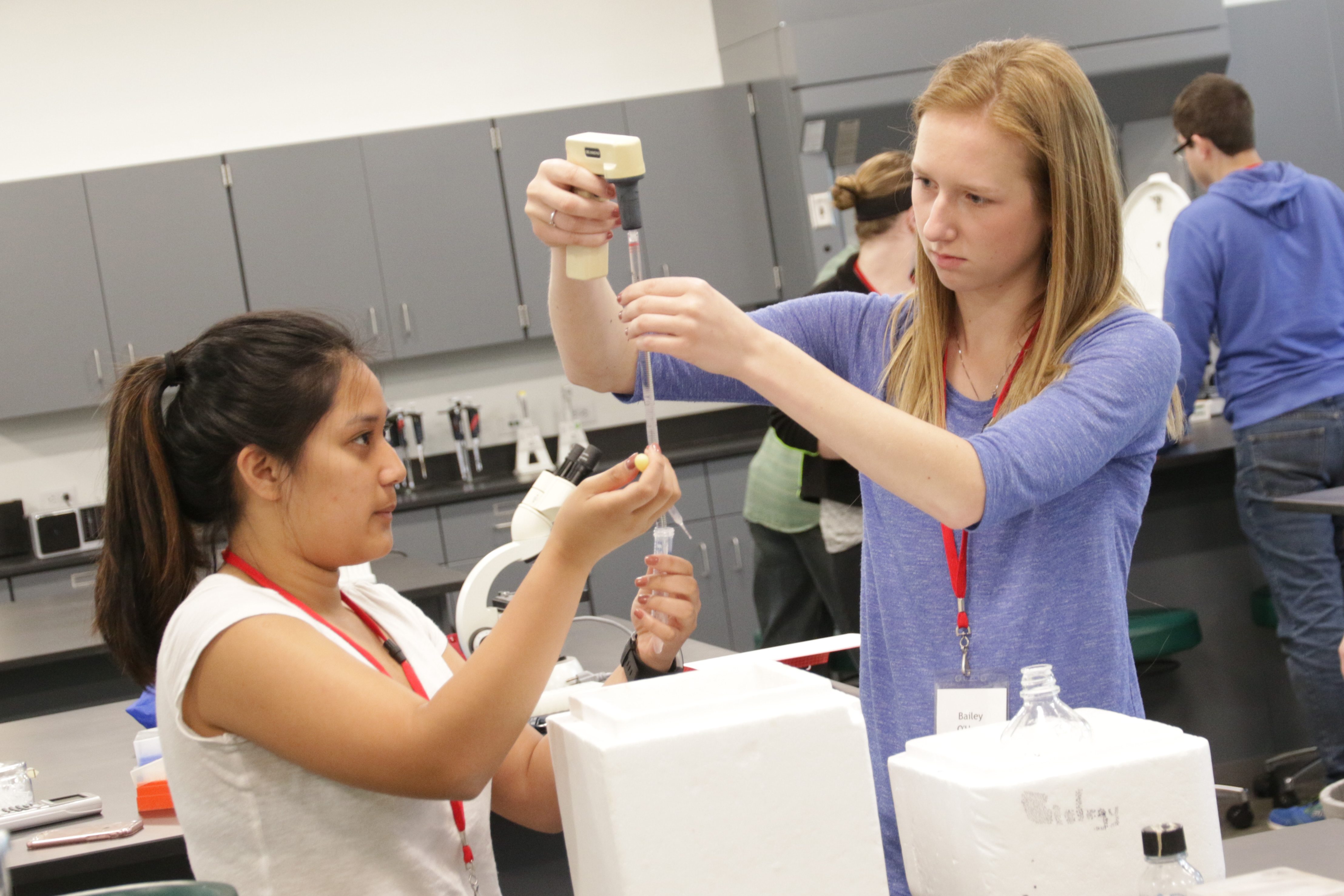
“We are currently working on cells that were extracted from a mouse liver and we are working to turn them into an induced pluripotent stem cell. Induced pluripotent stem cells are cells taken from adult tissue and then dedifferentiated back into a stem cell state,” O’Hare said. “We are also working with splenocytes, or spleen cells, from a mouse. B and T cells are specialized cells found within a spleen. We have had the wonderful opportunity to work with a flow cytometer, which identifies and potentially isolates cells based on molecules they express on the cell surface or intracellularly. Our cells were analyzed by the flow cytometer to determine the percentage of B cells and T cells in the splenocyte population.”
Each day guest speakers—from an orthopedic surgeon, to a physician scientist, to a medical ethicist—have been brought in to speak with participants. Students also will have the opportunity to tour the Center for Regenerative Medicine at the Mayo Clinic in Rochester, Minn.
“Although I am focused on direct patient contact, this workshop has helped me realize how much of a team aspect medicine really is,” O’Hare said. “Many people work behind the scenes to take these therapies from lab bench to bedside.
“I am so thankful for this opportunity,” O’Hare said. “The workshop has exceeded my expectations. I’ve enjoyed working on diseases or conditions with potential regenerative medicine treatments. They keep us busy, but we are all very excited each day to go back.”
The Advanced Regenerative Medicine workshop at Saint Mary’s is funded by a grant of nearly $100,000 from Regenerative Medicine Minnesota.
Participants in the workshop include:
STUDENT/HOMETOWN/INSTITUTION:
Elizabeth Atneosen / Woodbury, Minn. / Saint Mary’s University of Minnesota
Katherine Banovetz / Dusseldorf, Germany / College of Saint Benedict
Lucas Campbell / Stillwater, Minn. / Saint Mary’s University of Minnesota
Christelle Cayton / Madison, Wis. / Macalester College
Kaitlin Geisenhof / Little Falls, Minn. / College of Saint Benedict
Madeline Gibson / Neoga, Ill. / Illinois Wesleyan University
William Gillach / Lindstrom, Minn. / Saint John’s University
Alexander Holm / Red Wing, Minn. / Saint Mary’s University of Minnesota
Zachary Kinney / Johnsburg, Ill. / Illinois Wesleyan University
Siri Larsen / Duluth, Minn. / Hamline University
Channelle Ndagire / Stamford, Conn. / Macalester College
Bailey O’Hare / Rushford, Minn. / Saint Mary’s University of Minnesota
Madlyn Perry / River Falls, Wis. / Saint Mary’s University of Minnesota
Madeline Reding / St. Paul, Minn. / Hamline University
Erica Ristow / Lindstrom, Minn. / Saint Mary’s University of Minnesota
Andrea Speltz / Rollingstone, Minn. / Saint Mary’s University of Minnesota
Raelynn Speltz / Altura, Minn. / Saint Mary’s University of Minnesota
Daniel Velazquez / Chicago, Ill. / Saint Mary’s University of Minnesota
Ching-Tzu (Jeanie) Yu / Milwaukee, Wis. / Wisconsin Lutheran College
Photo caption: Saint Mary’s biology student Bailey O’Hare, right, works in the lab as part of the university’s Regenerative Medicine Workshop.
Exploring the possibilities of regenerative medicine
Two weeks ago Bailey O’Hare ’19 didn’t know that much about amyotrophic lateral sclerosis (ALS), and she knew even less about regenerative medicine.
As part of a new summer workshop at Saint Mary’s University, O’Hare is getting an in-depth look at how the emerging field of regenerative medicine could one day help patients suffering from ALS—as well as a multitude of other diseases and ailments.
O’Hare and 18 other select undergraduate sophomore and junior science majors from seven colleges are participating in Saint Mary’s first Advancing Regenerative Medicine (ARM) grant-funded workshop May 29-June 9 on the Winona Campus.
O’Hare, a junior Biology major at Saint Mary’s, said that she hopes to pursue a career in medicine, and she knew that learning more about the fast-growing field would be beneficial. “In many cases traditional medicine is limited to treating the symptoms of a disease and unfortunately not solving the root cause of the problem,” she said.
The groundbreaking and evolving discipline of regenerative medicine has tremendous potential to impact the treatment of diseases affecting various organ systems—from tissue growth for burn victims to growing new vital organs, such as hearts and kidneys.
“The potential for self-repair can lead to an improvement in the quality of life—and even sustain life—for many patients,” O’Hare said. “Major breakthroughs are just around the corner. In many cases researchers are working to be able to take cells from a patient suffering from a disease or condition, treat them to become an induced pluripotent stem cell, and inject them back into the same patient. This is very important because it alleviates the risk of rejection due to the need to suppress the immune system when cells from another individual are used.”
As part of the hands-on workshop, students have been broken into teams for theoretical and practical learning experiences. O’Hare’s team is researching, writing, and presenting about ALS. Students are also working on two lab projects in the cell culture labs of Saint Mary’s new Science and Learning Center.
“We are currently working on cells that were extracted from a mouse liver and we are working to turn them into an induced pluripotent stem cell. Induced pluripotent stem cells are cells taken from adult tissue and then dedifferentiated back into a stem cell state,” O’Hare said. “We are also working with splenocytes, or spleen cells, from a mouse. B and T cells are specialized cells found within a spleen. We have had the wonderful opportunity to work with a flow cytometer, which identifies and potentially isolates cells based on molecules they express on the cell surface or intracellularly. Our cells were analyzed by the flow cytometer to determine the percentage of B cells and T cells in the splenocyte population.”
Each day guest speakers—from an orthopedic surgeon, to a physician scientist, to a medical ethicist—have been brought in to speak with participants. Students also will have the opportunity to tour the Center for Regenerative Medicine at the Mayo Clinic in Rochester, Minn.
“Although I am focused on direct patient contact, this workshop has helped me realize how much of a team aspect medicine really is,” O’Hare said. “Many people work behind the scenes to take these therapies from lab bench to bedside.
“I am so thankful for this opportunity,” O’Hare said. “The workshop has exceeded my expectations. I’ve enjoyed working on diseases or conditions with potential regenerative medicine treatments. They keep us busy, but we are all very excited each day to go back.”
The Advanced Regenerative Medicine workshop at Saint Mary’s is funded by a grant of nearly $100,000 from Regenerative Medicine Minnesota.
Participants in the workshop include:
STUDENT/HOMETOWN/INSTITUTION:
Elizabeth Atneosen / Woodbury, Minn. / Saint Mary’s University of Minnesota
Katherine Banovetz / Dusseldorf, Germany / College of Saint Benedict
Lucas Campbell / Stillwater, Minn. / Saint Mary’s University of Minnesota
Christelle Cayton / Madison, Wis. / Macalester College
Kaitlin Geisenhof / Little Falls, Minn. / College of Saint Benedict
Madeline Gibson / Neoga, Ill. / Illinois Wesleyan University
William Gillach / Lindstrom, Minn. / Saint John’s University
Alexander Holm / Red Wing, Minn. / Saint Mary’s University of Minnesota
Zachary Kinney / Johnsburg, Ill. / Illinois Wesleyan University
Siri Larsen / Duluth, Minn. / Hamline University
Channelle Ndagire / Stamford, Conn. / Macalester College
Bailey O’Hare / Rushford, Minn. / Saint Mary’s University of Minnesota
Madlyn Perry / River Falls, Wis. / Saint Mary’s University of Minnesota
Madeline Reding / St. Paul, Minn. / Hamline University
Erica Ristow / Lindstrom, Minn. / Saint Mary’s University of Minnesota
Andrea Speltz / Rollingstone, Minn. / Saint Mary’s University of Minnesota
Raelynn Speltz / Altura, Minn. / Saint Mary’s University of Minnesota
Daniel Velazquez / Chicago, Ill. / Saint Mary’s University of Minnesota
Ching-Tzu (Jeanie) Yu / Milwaukee, Wis. / Wisconsin Lutheran College
Photo caption: Saint Mary’s biology student Bailey O’Hare, right, works in the lab as part of the university’s Regenerative Medicine Workshop.
Hussein dreams of justice in Ethiopia, everywhere
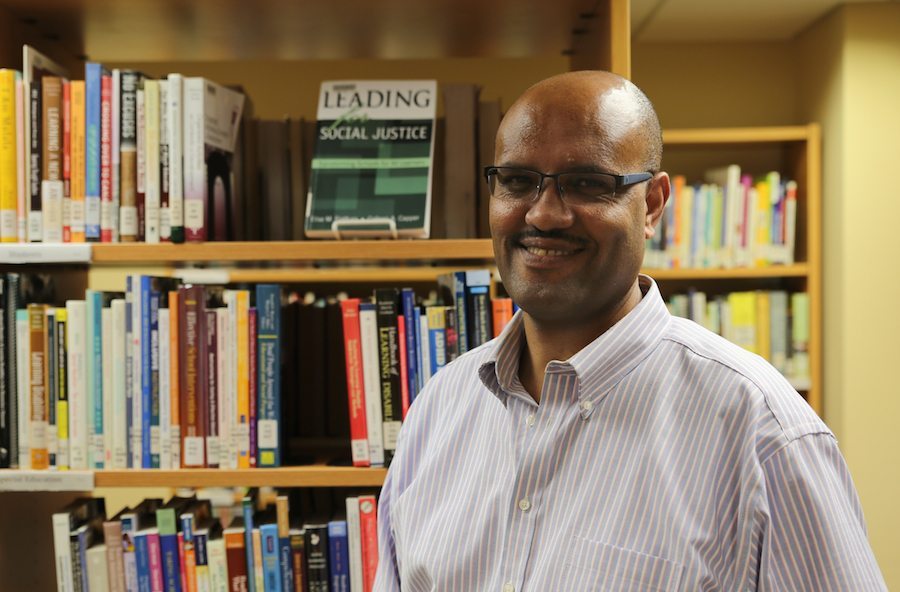
As Kassim Abbanesha Hussein crosses the Saint Mary’s University of Minnesota commencement stage on Saturday, June 3 to receive a Doctor of Business Administration diploma, part of his heart will remain in Oromia, Ethiopia.
Hussein fled his homeland 26 years ago—leaving behind an unspeakable level of danger and heartbreak.
At the tender age of 12, his beloved father was executed by the Ethiopian government because of his political beliefs. His oldest brother, his uncle, and two cousins were also killed for standing up against a corrupt dictatorial government. His youngest brother remains missing after 19 years.
“Ethiopia is in political crisis because of what the government is doing to our people,” he said. “People are simply demanding fairness and justice, and the government is responding with bloodshed. Although I came here 26 years ago, unfortunately people are still going through the same life and not knowing what will happen to them when they wake up the next day. As a child, we were suffering. I was afraid the government would come after us. Those who fight for justice and stand up are persecuted or killed. It is dangerous.”
Despite Ethiopia having one of the fastest-growing economies in the world, it remains one of the world’s poorest countries due to a high level of corruption within its government.
When Hussein was determining the topic of his dissertation, his memories weighed heavily in his decision, as did his desire to determine whether or not the United Nations Convention against Corruption legislation, negotiated in 2003, has benefited countries like Ethiopia.
In “Analysis of the Effectiveness of Anticorruption Legislation in Developing Countries: The Impact on the National Well-Being of Adopting Nations,” Hussein closely examined 43 developing countries, using series of well-being indicators.
The results, unfortunately, have shown that there have been no significant improvements in the well-being of the countries he studied. “The intent of the United Nations Convention against Corruption was to improve the well-being of adopting nations by reducing poverty and income inequality through the reduction of corruption, but my research is not showing that has occurred,” he said. “I believe this should be further researched. I found six countries which have been ranked as ‘most improved’ and four countries as ‘least improved’. I would like to explore what these countries have in common in the fight against corruption. Future research may investigate what the under-performing countries have in common. Moreover, it would be interesting to investigate the differences these countries have with the countries that are ranked as ‘most improved’.”
Hussein feels a strong pull to social justice. It was his personal connection to Saint Mary’s mission and core values that brought him to the Twin Cities Campus 14 years ago to begin his studies in the M.B.A. program.
“Saint Mary’s core values are very emotionally appealing for me,” he said. “I saw myself there when I read about Saint Mary’s concern for the poor and for social justice and its respect for all persons. That is very important to me.”
After finishing his M.B.A., he returned to the university for his D.B.A. On June 3, he will become Saint Mary’s first graduate in the D.B.A. program. During his studies at Saint Mary’s, Hussein specialized in business economics and finance.
A compliance analyst for U.S. Bank, Hussein hopes to use his leadership skills in his career but also hopes to teach part-time to help share his passion for social justice.
“My greatest hope for the future is to see justice not only in Ethiopia, but justice everywhere,” he said.
This is an exciting year for Hussein’s family. On April 22, his wife received her doctoral degree, and his son will be graduating June 8 from Minnesota Math & Science Academy (with 49 college credits through Post Secondary Enrollment Options).
Hussein said during his own academic journey, he received support from individuals throughout the Saint Mary’s community—from staff members though administration. “How students are treated, the respect I received personally, and the support I received … I could not ask for more,” he said. “I can say that it was the best experience, and I recommend any student to check out Saint Mary’s.
“I know any program is not easy,” Hussein said. “but the doctoral program was my hardest and longest experience that was made easier by the support I received from my family and from the entire Saint Mary’s community. They really helped me to be where I am today and I am so grateful to all those who supported me.”
Saint Mary’s is hosting three commencement ceremonies on June 3 at its Twin Cities Campus.
![Saint Mary’s dedicates Science and Learning Center [video]](https://newsroom.smumn.edu/wp-content/uploads/2018/03/SLCRibbonCutting.jpg)
Saint Mary’s dedicates Science and Learning Center [video]
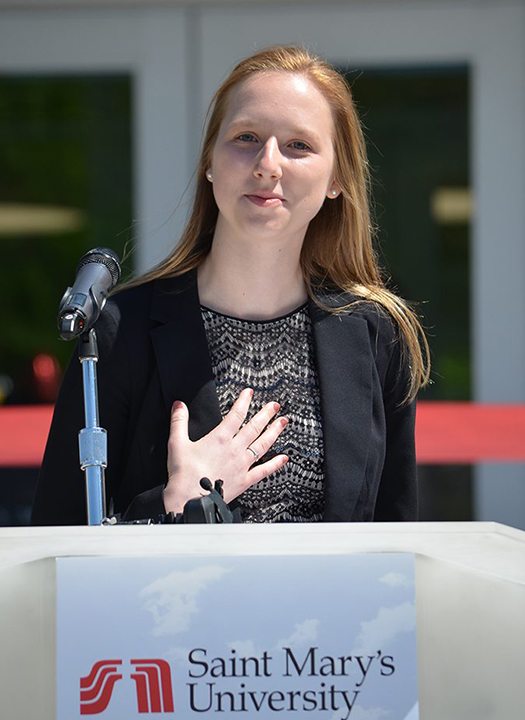
Saint Mary’s University junior biology major Bailey O’Hare joked that she’d make her speech short May 12 during the dedication ceremony for the new Science and Learning Center on the Winona Campus.
“Because I, like you, can’t wait to get inside,” she told the crowd of more than 400 people at the Winona Campus celebration.
 The completion of the $19.7 million project was the culmination of a long-time dream of the university. But the day wasn’t just about celebrating a 50,000-square-foot building; it was also about recognizing the innovative programming and enhanced learning that will soon take place inside.
Dr. Todd Reinhart, dean of the Sciences and Health Professions, said the building’s facilities will be put to use May 29 as 20 undergraduate students attend a two-week Advancing Regenerative Medicine workshop.
“Today truly is about more than a building,” he said. “We’re shaping a new vision in the sciences at Saint Mary’s at both the undergraduate and graduate levels.” For example, he cited Saint Mary’s new physician assistant master’s degree program being developed through a collaboration with Mayo Clinic School of Health Sciences. “This is an area where skilled medical workers are desperately needed, and we’re excited to begin training these future physician assistants in the fall of 2018,” he said. “As part of this collaboration, we are expanding our Cascade Meadow facility in Rochester.”
These are the types of initiatives that O’Hare said are further fueling her passion for sciences.
“When I was looking at where I wanted to pursue my undergraduate studies, I was drawn to Saint Mary’s because of its reputation for having a strong science program,” she said. “Being able to study in this new facility will give Saint Mary’s students an even greater advantage in preparing them for their future careers.”
Audrey Kintzi, vice president for Development and Alumni Relations, announced that—through the generosity of benefactors—$19.4 of the building’s $19.7 million cost has already been raised.
Brother William Mann, Saint Mary’s president, referenced several songs during his remarks, including the John Denver lyrics, “If I had a day that I could give you, I’d give to you the day just like today. “But I’m not the one giving you this day,” he said. “WE’RE the ones and GOD is the one giving us this gloriously sunny day — and heart-filled and heart-open generous benefactors who have helped this university realize this dream.”
Another song lyric Brother William referenced was the Beatles’ “I get by with a little help from my friends.”
“When we go through the doors, on the left was supposed to be the benefactor wall of recognition. We had to adjust because the names of the people who gave the more than $19 million that has already been given, were too many to fit. So you’ll find names on the left and the right because we get by with a little help from our friends.”
Brother William said the music title he’d give to the dedication day was, appropriately, Beethoven’s Ode to Joy.
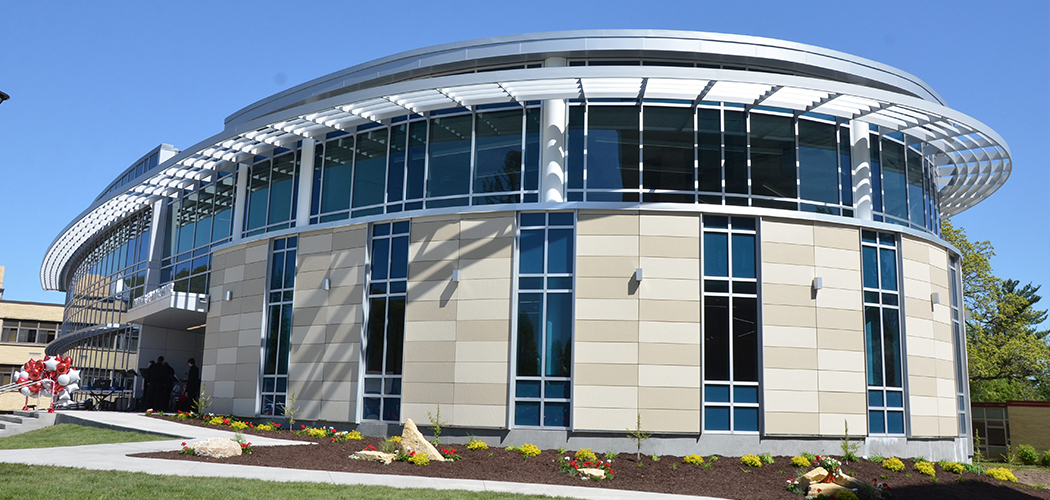 “Our contribution to the public good, to civic welfare is that we are helping our nation reach and achieve its goals by doing this work, which prepares tomorrow’s leaders,” he said. “Educating science and business leaders of tomorrow is going to happen in this building. For that I am grateful to all of you who made this possible.”
O’Hare also thanked those who contributed to the Science and Learning Center. “Because of you, I will finish my academic career here, in this state-of-the-art facility, surrounded by dedicated and knowledgeable faculty members,” she said. “And I will forever be blessed by your generosity. Thank you for making today possible.”
For more photos, go here.
Graduate scores on the court and in class
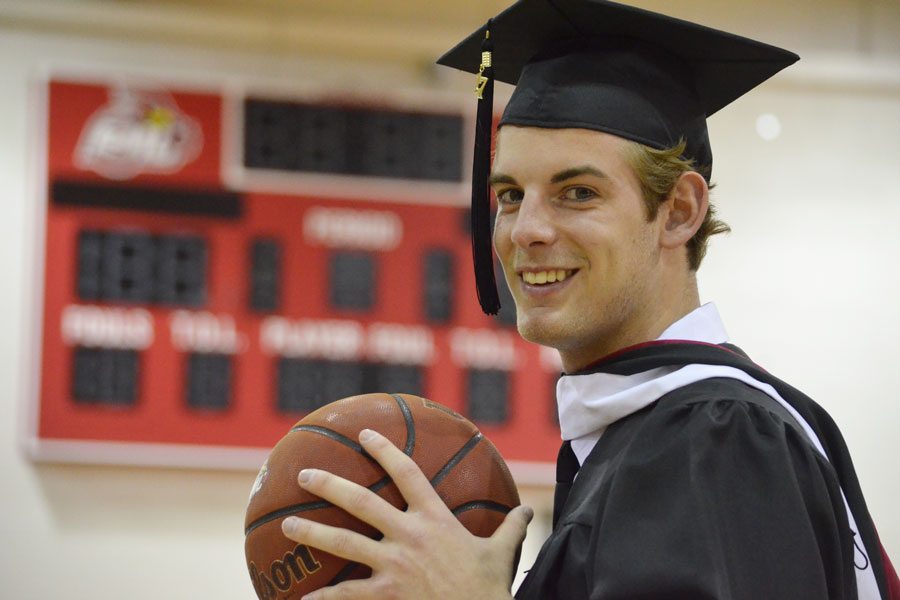
Wylie Ferron ’17 may not be dressed in his usual Cardinal red, but he will definitely have the home-court advantage when he dons a cap and gown and hits the gym floor Saturday for Saint Mary’s University’s Winona commencement ceremony.
As a three-year captain of the men’s basketball team, Ferron has engineered many successful basketball performances during his college athletic career; this fall he’ll pursue a graduate degree in civil engineering.
For four years, Ferron achieved high scores in basketball, closing out his senior year as the team’s scoring leader, averaging a career-best 14 points per game. A Math major and Chemistry minor, he also scored well in classes ranging from probability to abstract algebra.
But he admits the abstract, theory-based math classes stretched and challenged him.
“I’ve always wanted to get into engineering,” he said. “I’ve always loved working with numbers and problem solving. In math, once you learn about patterns, it becomes fun.”
In basketball, he said, he learned that his tendency to find the patterns could be both good–and bad. “Sometimes you have to go off script,” he said. “I learned as much from basketball as I have from math when it comes to the real world.”
The Waconia, Minn., native was recruited to Saint Mary’s to play basketball, but found he fell in love with the campus and the Winona area and knew he’d found the perfect fit. “I debated whether or not I would play basketball in college, but I’m really glad I did,” he said. “It kept me focused. We have a pretty close-knit team, even though we’re all from different backgrounds.”
He said juggling athletics and academics taught him about time management and kept him on task.
It also taught him leadership skills he believes will be valuable as he heads to Oregon State in Corvallis, Ore., to pursue a master’s degree in civil engineering. He looks forward to studying at a renowned engineering school with facilities dedicated for structural testing and geotechnical engineer. The school’s wave lab is internationally recognized and features the worlds’ largest tsunami wave basin.
This summer, he’ll complete an internship with Danny’s Construction in Shakopee, which completed much of the structural work for U.S. Bank Stadium.
The summer after his sophomore year, he worked with the City of Winona Engineering Department doing surveying. This experience helped solidify his career path. “It gave me a good idea of some of the operations and tasks of construction projects,” he said. “It also taught me about some of the language of the engineering world.”
Eventually, his goal is to lead construction teams as a project manager on large-scale developments like stadiums, bridges, and large buildings.
“I think one of the things that will benefit me the most in my career in management has been learning how to work together as a team,” he said.
Ferron said he and Coach Jamison Rusthoven worked together to change the culture of the men’s basketball team during his four years at Saint Mary’s. “Coach Rusthoven has been a good mentor, and I definitely give him credit for my growth as a leader,” Ferron said. “I’ve grown a lot in that area, and I want to keep learning.”
Ferron describes a good leader as someone “who knows the people you are working with and how to bring the best out of them. You have to know how to motivate and push them to reach their maximum potential and maintain a good balance between encouragement and holding people accountable. You also need to know your goals and outcomes, so you have a vision of where you’re going so you can direct everyone for the benefit of the team.”
Ferron said that as he crosses the stage Saturday, he knows he will miss a lot about Saint Mary’s. “I formed a lot of close relationships with the coaching staff, faculty and my friends,” he said. “That’s the thing about going to a smaller school, there are more opportunities to build those relationships. I’ll also miss basketball, but I feel like I put everything I had into it, and I got everything I wanted to out of it.”
More information about Saturday’s Winona Campus commencement ceremony.




© Copyright 2016. All Rights Reserved. | Privacy | Site Feedback/Changes | Accreditation